WAG: Query-Conditioned Graph Retrieval for Contextualized LLM Reasoning in Personalized Wearable Data
AACL 2026 (Oral)
1Carnegie Mellon University 2University of California, Irvine
Abstract
The growing prevalence of multi-sensor wearable devices generates vast amounts of long-term, multimodal time-series data, posing significant challenges for context-aware Large Language Models (LLMs). Current LLM-based health analysis methods typically rely on manually curated context, which becomes impractical with increasing data volume and sensor diversity. To overcome these limitations, we introduce Wearable As Graph (WAG), a novel framework that automates context retrieval for LLMs using personalized knowledge graphs. WAG constructs knowledge graphs mapping relationships between wearable modalities and incorporates user-specific data. We develop a data-driven retrieval pipeline that leverages both global (long-term) and local (short-term) relationships within metrics to identify the most relevant nodes for user queries. We evaluate WAG on a benchmark of over 10k data-associated queries created from multiple wearable datasets. WAG consistently delivers the strongest overall performance, while using substantially fewer input tokens than query-window full-context prompting in the diagnostic setting. These gains remain broadly consistent under human evaluation and across a cross-model generator–judge matrix, supporting structured, query-adaptive context retrieval for LLM-driven analysis of wearable data.
Method
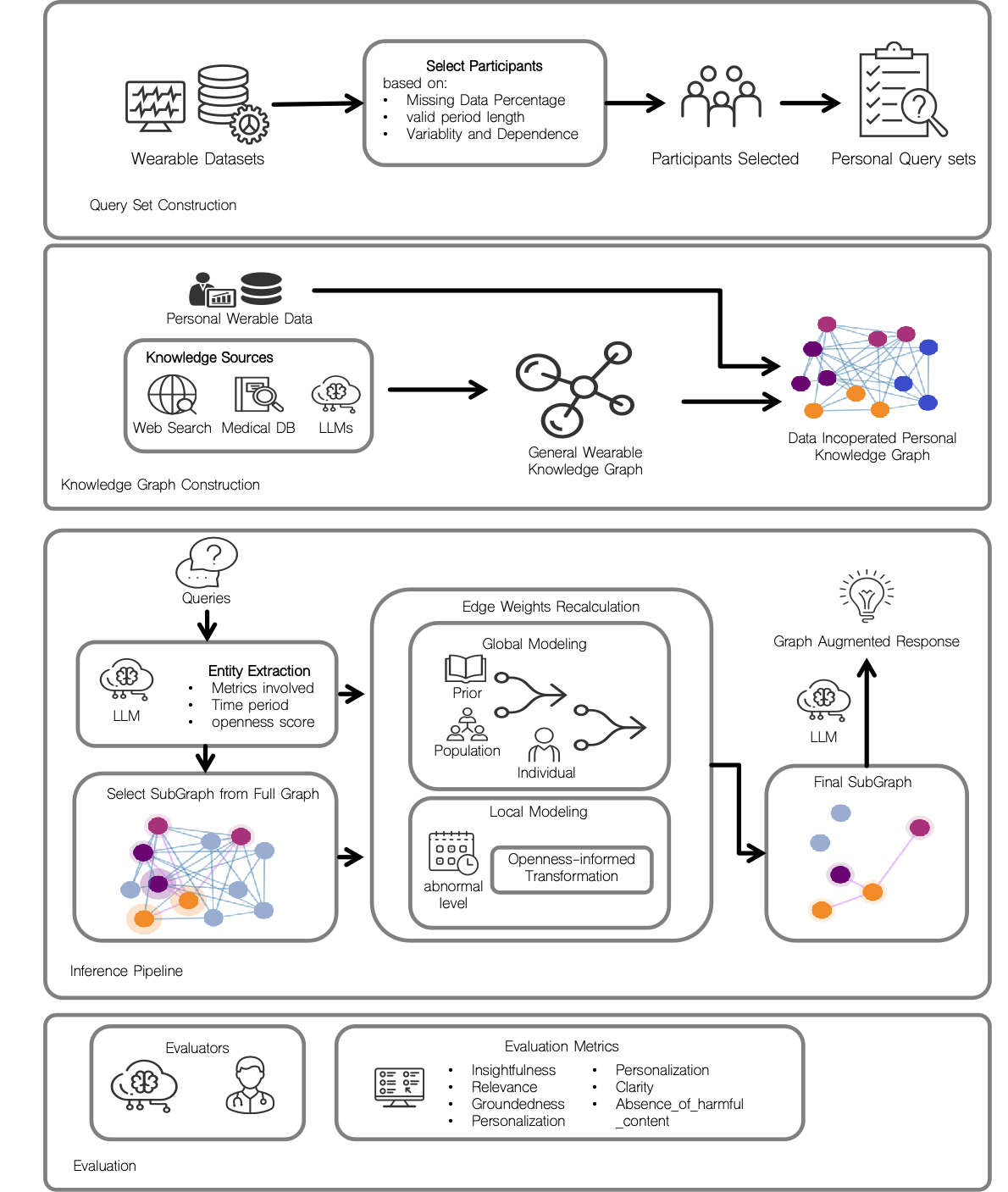
Overview of WAG. (1) Data-grounded query sets are generated from selected participants. (2) A general wearable knowledge graph is built from medical sources and LLMs, then specialized into a personal knowledge graph with the user's own signals. (3) For each query, entities, time period and an openness score are extracted; edge weights are updated by global and local modeling, and the resulting subgraph conditions generation. (4) Responses are judged by LLM and human evaluators.
Knowledge Graph
The graph behind WAG links 102 health metrics with 5,151 weighted relations; every pair carries a prior relation strength derived from medical sources, web evidence and LLM reasoning. Raise the threshold to keep only strong relations, filter by category, or click a metric to read its definition, normal range and strongest neighbours.
Datasets
The query benchmark is built on four public wearable datasets. Of the graph's 102 metrics, 52 are linked to recorded data; a check mark shows which datasets record each one.
| Metric | GLOBEM | IFH Affect | LifeSnaps | PMData |
|---|---|---|---|---|
| Physiological | ||||
| Blood oxygen saturation | ✓ | |||
| Skin conductance | ✓ | |||
| HRV RMSSD | ✓ | ✓ | ||
| Resting heart rate | ✓ | ✓ | ||
| Nightly skin temperature | ✓ | |||
| Sleep breathing rate | ✓ | ✓ | ||
| Temperature Variation | ✓ | ✓ | ||
| VO2 Max | ✓ | |||
| Sleep | ||||
| Total sleep duration | ✓ | ✓ | ✓ | ✓ |
| Sleep onset latency | ✓ | ✓ | ✓ | ✓ |
| Wake after sleep onset | ✓ | ✓ | ✓ | ✓ |
| Sleep efficiency | ✓ | ✓ | ✓ | ✓ |
| Circadian rhythm patterns | ✓ | |||
| Asleep duration | ✓ | ✓ | ✓ | ✓ |
| Light sleep duration | ✓ | ✓ | ✓ | |
| Deep sleep duration | ✓ | ✓ | ✓ | |
| REM sleep duration | ✓ | ✓ | ✓ | |
| Bedtime start time | ✓ | ✓ | ✓ | |
| Bedtime end time | ✓ | ✓ | ✓ | |
| Midpoint of sleep | ✓ | |||
| Time after wakeup | ✓ | ✓ | ✓ | |
| Mental | ||||
| Mental stress | ✓ | ✓ | ||
| Mental fatigue | ✓ | |||
| Mood | ✓ | ✓ | ||
| PANAS positive affect | ✓ | ✓ | ✓ | |
| PANAS negative affect | ✓ | ✓ | ✓ | |
| Anxiety | ✓ | |||
| Depression | ✓ | |||
| Metric | GLOBEM | IFH Affect | LifeSnaps | PMData |
|---|---|---|---|---|
| Activity | ||||
| Steps taken | ✓ | ✓ | ✓ | ✓ |
| Distance traveled | ✓ | ✓ | ✓ | |
| Active time | ✓ | ✓ | ✓ | ✓ |
| Energy expenditure | ✓ | ✓ | ✓ | |
| Resting time | ✓ | |||
| Inactive time | ✓ | ✓ | ||
| Lightly active time | ✓ | ✓ | ✓ | |
| Moderately active time | ✓ | ✓ | ✓ | |
| Highly active time | ✓ | ✓ | ✓ | |
| Exercise | ✓ | ✓ | ||
| Step goal | ✓ | |||
| Lifestyle | ||||
| Lifelog | ✓ | ✓ | ||
| Number of calls | ✓ | |||
| Entropy of call duration | ✓ | |||
| Number of phone unlock | ✓ | |||
| Duration of phone unlock | ✓ | |||
| Time at home | ✓ | |||
| The Radius of Gyration | ✓ | |||
| Maximum distance from home | ✓ | |||
| Demographic | ||||
| Age | ✓ | |||
| Gender | ✓ | |||
| BMI | ✓ | |||
| Personality | ✓ | ✓ | ||
| Environmental | ||||
| Barometric pressure | ✓ | |||
Resources
Wearable knowledge graph
102 metric nodes with UMLS grounding, definitions, normal ranges and recommendations; 5,151 weighted, evidence-backed relations.
Query benchmark
10,341 data-grounded queries over 40 subjects from four public datasets, annotated with query type, time window and abnormality level.
The four source datasets — GLOBEM, IFH Affect, LifeSnaps and PMData — are released by their original authors and must be obtained from them under their own terms. This repository ships the derived graph, the generated query set and the processing code.
Citation
@inproceedings{lu2026wag,
  title     = {{WAG}: Query-Conditioned Graph Retrieval for Contextualized
               {LLM} Reasoning in Personalized Wearable Data},
  author    = {Lu, Zhenyu and Abbasian, Mahyar and Rahmani, Amir M.},
  booktitle = {Proceedings of the 5th Conference of the Asia-Pacific Chapter of
               the Association for Computational Linguistics and the 15th
               International Joint Conference on Natural Language Processing
               (AACL-IJCNLP 2026)},
  year      = {2026}
}